Evolution of Heuristics: Towards Efficient Automatic Algorithm Design Using Large Language Model
1. Introduction
The paper uses Evolutionary Computation (EC) in the standard sense: keep a population of candidates → evaluate them (fitness) → generate variations → select the better ones → repeat.
A new evolutionary paradigm, dubbed Evolution of Heuristics (EoH), is introduced, and it takes advantage of both LLMs and EC for Automatic Heuristic Design (AHD). It is an evolutionary framework to simultaneously evolve the thoughts and codes of heuristics in a cooperative manner.
thought – a high-level idea of heuristic
code – an executable implementation of heuristic
Contributions:
- EoH, a paradigm that uses LLMs to evolution both thought and codes for automatic design of heuristics.
- Several prompt strategies to guide LLM towards generating more diverse and effective heuristics.
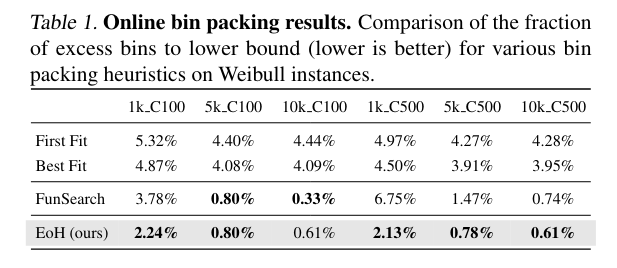
- Evaluation of EoH on three widely-studied combinatorial optimization benchmark problems, where EoH outperforms many existing AHD methods.
2. Evolution of Heuristics (EoH)
2.1 Main Idea
EoH aims at evolving both thoughts and codes to mimic the heuristic development conducted by human experts. To achieve this goal, EoH
maintains both a natural language description and its corresponding code implementation for each heuristic. n each trial, it allows LLMs to first generate a heuristic in terms of natural language and then generate its corresponding code.
- employs several prompt strategies to guide LLMs to do reasoning over existing thoughts and codes. These strategies are designed to learn from previous experiences and effectively explore the heuristic space.
- evolves a population of candidate heuristics. It uses LLMs to produce new heuristics. Selection is also used to direct the search. The quality of each heuristic is evaluated on a set of problem instances.
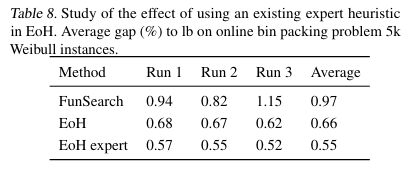
FunSearch performs evolution of codes only and does not use prompt strategies explicitly.
2.2 Evolution Framework
EoH maintains a population of $N$ heuristics, denoted as $P = {h_1, …, h_N}$, at each generation. Each heuristic $h_i$ is evaluated on a set of problem instances and assigned a fitness value $f(h_i)$.
Five prompt strategies are designed to generate new heuristics. At each generation, each strategy is called $N$ times to generate $N$ heuristics. Each newly generated heuristic will be evaluated on problem instances and added to the current population if it is feasible. At most $5N$ new heuristic will be added to the current population at each generation. Then, $N$ best individual solutions from the current population will be selected to form the population for the next generation.
EoH are summarized as follows:
Step 0 Initialization: Initialize the population $P$ of $N$ heuristics $h_1, …, h_N$ by prompting LLMs using Initialization prompt.
Step 1 Generation of Heuristics: If the stopping condition is not met, five Evolution prompt strategies are used simultaneously to generate $5N$ new heuristics. For each of the five prompt strategies, repeat the following process $N$ times:
- Step 1.1: Select parent heuristic(s) from the current population to construct a prompt for the strategy.
- Step 1.2: Request LLM to generate a new heuristic as well as its corresponding code implementation.
- Step 1.3: Evaluate the new heuristic on a set of evaluation instances to determine its fitness value.
- Step 1.4: Add the new heuristic to the current population if the heuristic and code are feasible, if not, simply skip.
Step 2 Population Management: Select the N best individual heuristics from the current population to form a population for the next generation. Go to Step 1.
2.3 Heuristic Representation
Each heuristic consists of three parts: 1) its description in natural language, 2) a code block in a pre-defined format, and 3) a fitness value.
The heuristic description comprises a few sentences in natural language. It is created by LLMs and presents a high-level thought.
The code block is an implementation of the heuristic. It should follow a pre-defined format so that it can be identified and seamlessly integrated into EoH framework. In the experiments, they choose to implement it as a Python function. Three basic components should be explicitly given to format the code block: 1) Name of the function, 2) Input variables, and 3) Output variables.
The evaluation of heuristics in EoH involves running the resulting algorithms on an instance set of the problem in question. This evaluation process differs from traditional evolutionary algorithms, which typically evaluate the objective function in a single instance.
2.4 Prompt Strategies
Initialization Prompt. In their experiment, they use LLMs to create all the initial heuristics using initialization prompts. With initialization prompt, they inform the LLM with the heuristic design task and instruct it to design a new heuristic by first presenting the description and then implementing it as a Python code block. They repeat $N$ times to generate $N$ initial heuristics. Initialization prompt is to be written by user manually.
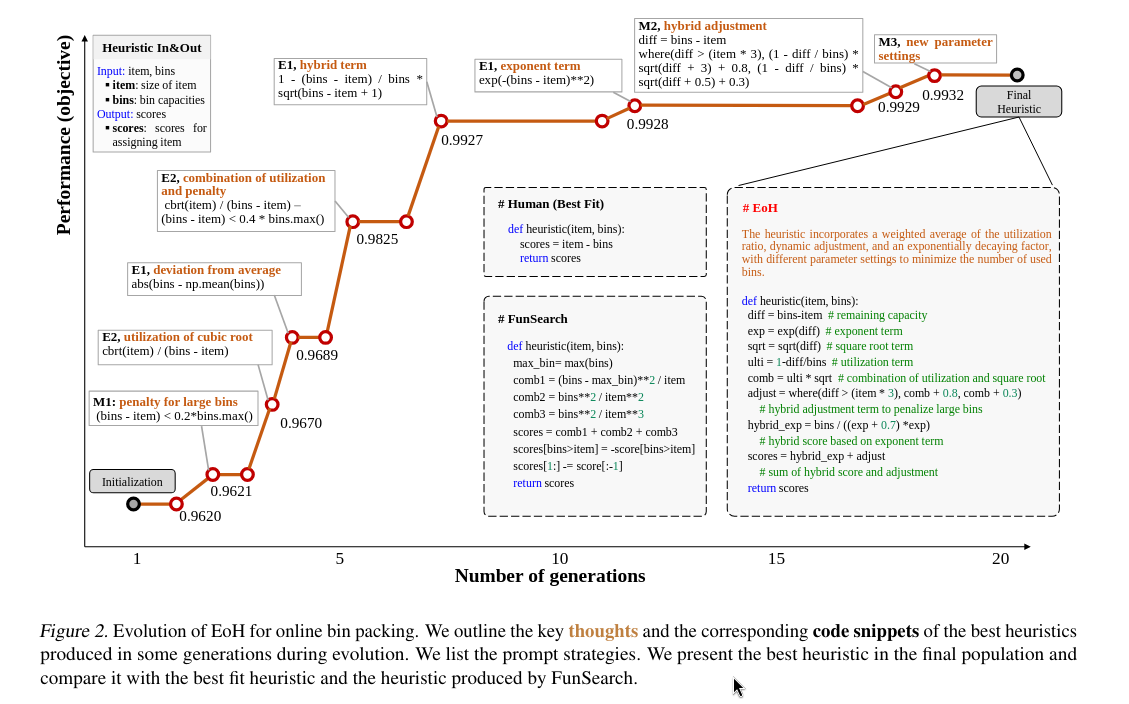
Evolution prompts. Five prompt strategies are proposed for creating new heuristics. They are categorized to two groups: Exploration (E1, E2), and Modification (M1, M2, M3). The exploration strategies focus more on the exploration of the space of heuristics. The exploration strategies focus more on
- E1: From selected $p$ heuristics out of parent heuristics, generate a new heuristic that is as much different as possible.
- E2: From selected $p$ heuristics out of parent heuristics, generate a new heuristic that is different but shares the same idea.
- M1: Modify the selected heuristic for better performance.
- M2: Modify the parameters of the selected heuristic.
- M3: Simplify the given heuristic.
Any selection method can be used in EoH. In their experimental studies, heuristic in the current population is randomly selected with probability $p_i ∝ 1/(r_i + N )$, where $r_i$ is its rank and $N$ is the population size.
2.5 Sample Workflow
Init:
- Population $P_0$ has 5 heuristics ($h_1$..$h_5$), each evaluated → fitness assigned.
For each generation g = 1..5:
- Offspring attempts: 5 strategies × N calls = 5×5 = 25 candidates.
- Keep only feasible ones: $k_g $ feasible (0 ≤ $k_g $ ≤ 25).
- Evaluate each feasible candidate → fitness.
- Temporary pool size: 5 + $k_g$ (≤ 30).
- Select best 5 by fitness → $P_g$.
Population size at start of every generation: 5.
Example $k_g $ values:
- Gen1: $k_1$=22 → pool 27 → keep 5
- Gen2: $k_2$=24 → pool 29 → keep 5
- Gen3: $k_3$=20 → pool 25 → keep 5
- Gen4: $k_4$=25 → pool 30 → keep 5
- Gen5: $k_5$=23 → pool 28 → keep 5
3. Experiments
Results
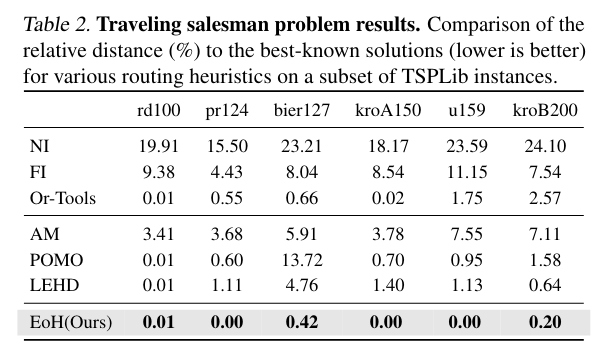
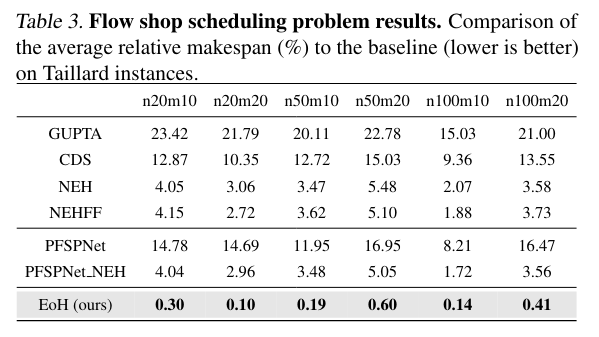
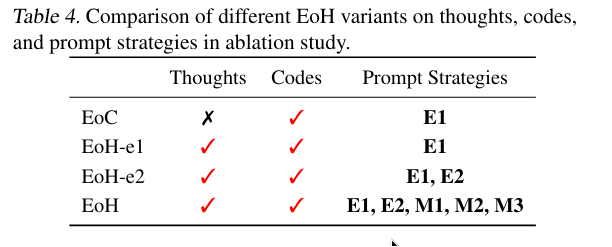
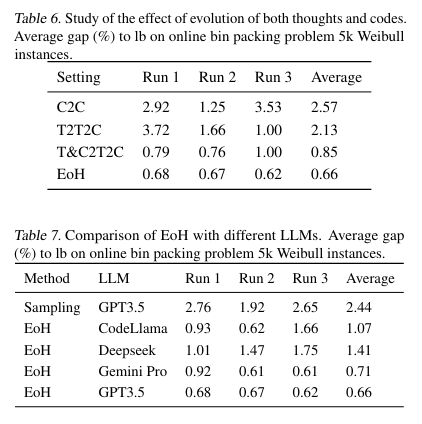
An ablation study is carried out to provide a better understanding of the contribution of major components in EoH. They consider the following variants of EoH:
- EoH-e1: it doesn’t use the three modification prompt strategies and E2, i.e. It uses only E1.
- EoH-e2: it doesn’t use the three modification prompt strategies, i.e. It uses only E1 and E2.
- EoC: it is the code-only variant of EoH. It doesn’t include the thought part (i.e. the description of the heuristic in natural language). EoC only uses E1 (with-out linguistic description) to generate new codes. The number of parents $p = 5$.
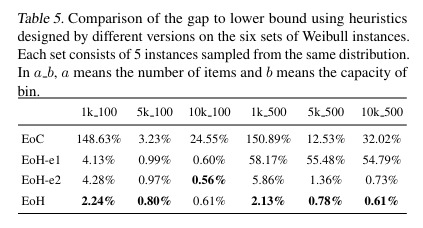
The source code can be found in https://github.com/FeiLiu36/EoH